
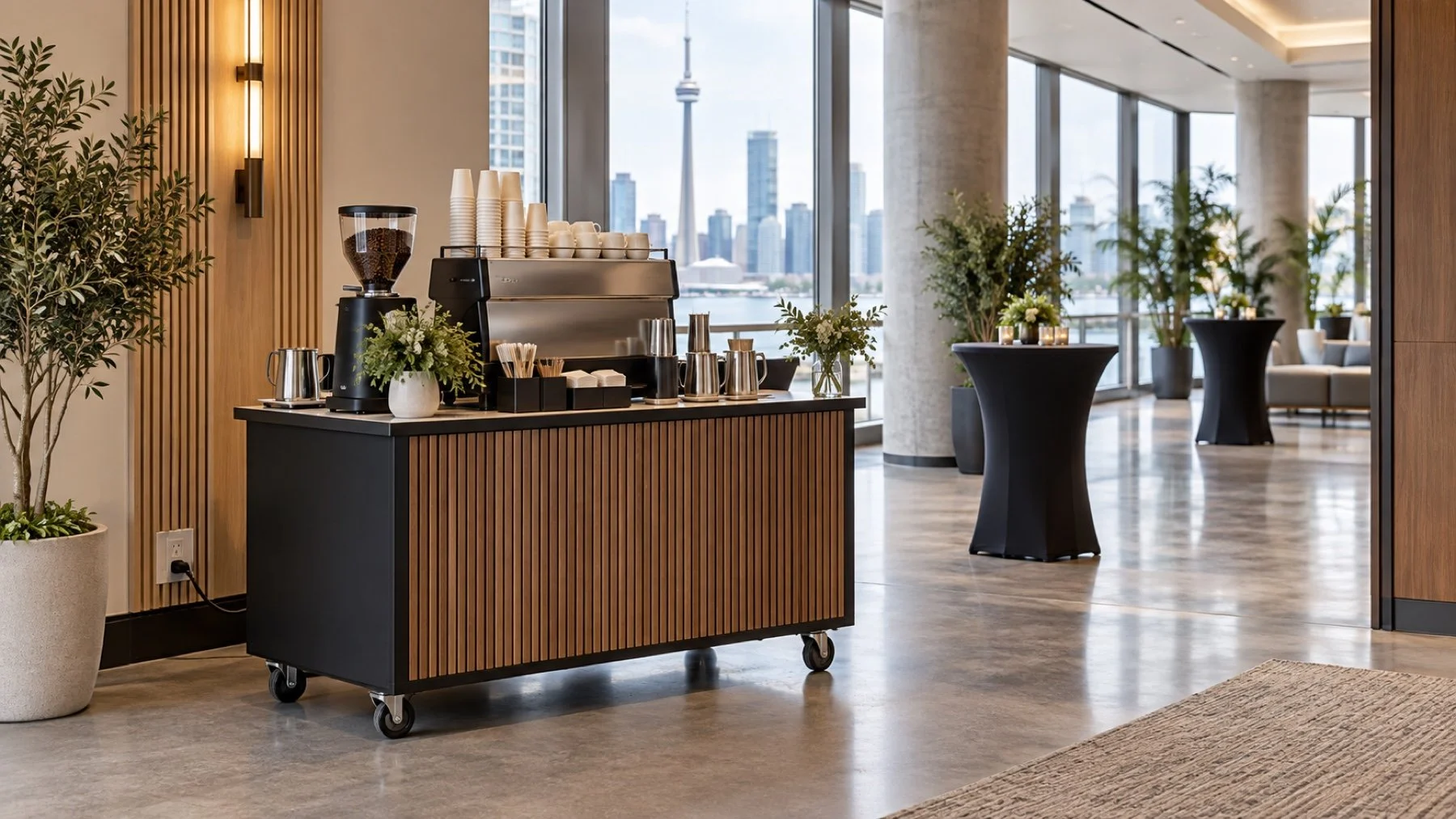
Coffee station rental planning begins by confirming that the venue can support the staffed setup. At NO.3 Coffee, we review placement and access with the event brief.
A polished corner near the ballroom doors may look perfect for a coffee station. It can still fail the venue check if the loading route is restricted, the proposed connection is unavailable or the waiting area blocks guest movement. Confirm the operating plan before treating the location as booked.
For a staffed coffee station rental, ask what service is included, then have the venue approve the exact setup. NO.3 Coffee offers mobile espresso bar and coffee cart formats. The current proposal should define placement, access, power, service flow and setup needs without relying on conflicting general figures.
The Coffee Association of Canada reported 71 percent daily coffee beverage consumption in its 2025 study. The broad figure explains why a station can serve a familiar demand, while the venue review determines whether the proposed location can support it.
The venue checklist should include any food vendor records required for the event. Toronto Public Health guidance for organizers outlines verification steps, while the supplier must provide its own current evidence.
Confirm that rental means the service you expect
Some rental searches lead to equipment only. Others describe a staffed mobile bar with baristas, drinks and event operations. State which one you need. If the guest experience depends on made to order drinks, ask the proposal to identify the staff, equipment, menu and service window together.
NO.3 Coffee’s offering is a staffed event service rather than a bare machine rental. Even so, the written quote should state every inclusion. Do not assume cups, ingredients, setup or cleanup from the word rental alone.
Choose a location that works beyond the floor plan
Mark the guest entrance, food service, doors, ramps, washrooms, emergency exits and staff corridors. Place the station where guests can see it without gathering in a narrow path. Ask where the menu will be visible before the order point and where people can step after receiving a drink.
Share current photos and room measurements, then ask the supplier what its selected setup needs. NO.3 Coffee publishes differing footprint details across pages, so this guide does not repeat one number. The event specific plan should carry the approved dimensions.
Verify loading and access from curb to station
Document parking or loading, dock booking, elevator dimensions, stairs, security, floor protection and the time the route becomes available. Identify the venue contact who can open doors and approve the final location. A service can be suitable for the room but impractical if equipment cannot reach it on schedule.
For a room turn, say when the supplier may enter and what other crews will be using the route. If setup overlaps catering, production or decor, assign priorities in the event schedule. Do not rely on a general setup duration because configuration and access differ.
Ask the venue to confirm the operating requirements
Request the supplier’s current power and placement requirements for the exact equipment. Send them to the venue and obtain a written response. NO.3 Coffee’s pages contain different outlet descriptions, so a planner should not choose one figure. The approved proposal must resolve the requirement for that station.
Ask about water, waste, floor protection and any food vendor documents the venue requires. For Toronto special events, organizers should also review applicable public health obligations. Do not claim that a supplier holds a registration or inspection unless the current evidence is provided.
Complete one venue handoff before signing
Put the floor plan, station photo, loading route, access time, operating requirements, service window, menu, venue contact and fallback location into one handoff. Mark every item as confirmed or open. The planner, venue and supplier should be able to read the same page and understand what happens next.
Review the NO.3 Coffee mobile espresso bar, the mobile coffee cart, and the full event service overview. Ask the team which format fits the confirmed venue conditions.
Hold a venue review before the booking is final
Bring the venue contact and coffee supplier into one review. Start with the proposed station location, then work backward to the loading point. Confirm doors, elevators, security, floor protection and the time the route becomes available. Next, work forward from the counter to the guest queue and pickup area. This two direction review catches problems that a floor plan alone often hides.
Ask the supplier to describe the selected equipment and its current operating requirements. Send those requirements to the venue without rewriting them. NO.3 Coffee publishes different figures on different pages, so this checklist does not choose one amperage, footprint or setup time. The event specific proposal and venue confirmation must carry the effective values for this booking.
Resolve water, waste and cleaning responsibilities. A station may use self contained systems for part of the operation, but planners should not assume that removes every venue need. Ask what the selected service requires, where waste goes and what surface protection applies. For a Toronto special event, review the public health process that applies to the organizer and food vendors without claiming a registration or inspection that has not been produced.
Test the location during the busiest five minutes
Picture the exact moment when the room releases guests. Are people leaving an auditorium, arriving from elevators or moving between sessions? Place the menu where it can be read before the order point. Leave a clear route for people who are not using the bar. Identify where completed drinks are collected so the pickup area does not fold back into the waiting line.
Check nearby event functions. A coffee station beside registration, coat check or food service can create overlapping queues even when each element fits on the drawing. Shift one function or stagger its opening. Keep emergency exits, ramps and staff corridors clear. Ask the venue to approve the practical layout, not merely the room name.
Close the review with a one page handoff. Include the approved position, photographs, loading route, access time, power response, service window, menu direction, venue contact and fallback location. Mark each line confirmed or open. Attach the supplier proposal rather than copying terms into the handoff. This record gives every team the same venue truth before equipment arrives.
Require a signed off location, not a placeholder dot
A floor plan symbol becomes useful only after the venue and supplier approve what it represents. Add the station orientation, guest approach, pickup side and working clearance around it. Mark nearby outlets or connections only after the venue confirms they can support the proposed equipment. Keep cords and service routes out of public circulation.
Photograph the location from the loading approach and guest approach. Include enough context to show doors, furniture and neighbouring event functions. Close crops can hide the exact obstacle that matters. Save the approved image set with the venue handoff so a replacement contact can understand the decision without repeating the entire walkthrough.
Treat any later room change as a fresh review. The same station may face different access, power or queue conditions across rooms in one building. Send the new location to the supplier and obtain venue confirmation again. A reusable checklist makes that review faster, but it does not make locations interchangeable.
If the station will move during the event, plan each location as a separate setup. Confirm the route, timing, public circulation and operating requirements for both. Decide whether equipment moves while guests are present and who controls the transition. A room turn or lobby change can affect power, floor protection and menu visibility even within the same venue. Ask the supplier whether movement is practical for the selected station and include the approved sequence in the run of show. Do not promise continuous service through a move unless the current proposal explicitly supports it.
Ask facilities or the venue manager to attend the final review when the building has complex access. They can confirm the approved route, electrical source, waste process, floor protection and security procedure. Record the response beside the supplier requirement, then close the item only when both sides agree. If the venue cannot support the proposed position, choose another location or service format before signing. The checklist is successful when it changes an unworkable plan early, not when every box is marked yes. Save the approved response with the final venue record for event day.
Share the approved station position with whoever manages the room on event day. Ask them to confirm that furniture, signage and catering tables will still match the reviewed plan when the supplier arrives. If the setup changes after the walkthrough, send a revised drawing or photograph to the supplier before load in, while there is still time to choose a workable position.
Check the venue plan before booking
- Staffed service or equipment only
- Venue approved station location
- Guest path and waiting area
- Loading route and access time
- Current power and placement requirements
- Venue documents, contact and fallback plan
Plan your NO.3 Coffee service
Send NO.3 Coffee the venue plan before the booking is finalized. Request a custom station recommendation and quote for the exact location. We serve Toronto and the GTA. Review the current service area.